

“Planning seeks to control and close the future, while futures studies seeks to open up the future, moving from ‘the’ future to alternative futures.” – Sohail Inayatullah
Thinking about the future in the plural is a small imposition on the fatalistic, linear mind. But if we only look at the most likely point of future development rather than its shimmering space of possibilities, we might as well give up any claim to shaping the future and retreat into the defensive game of anticipation and adaptation. Futures, then – and, so as not to get lost: plausible futures.
One voice that is shaping the discourse on futuring like no other at the moment is that of Sohail Inayatullah. Grounded in political science and macrohistory, the Queensland-based futurist and think tanker (Metafuture) captures the spirit of these turbulent times with his critical, transformative approach and the toolkit of the “Six Pillars of Futures Thinking”.
A very accessible mapping tool from this collection is the Futures Triangle. The model helps make visible the forces that frame the space of plausible futures in a social system. The triangle spans three reference points:
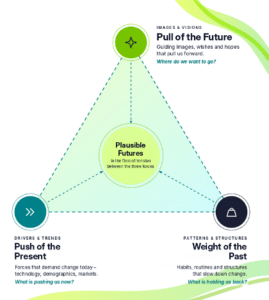
- The push of the present, which arises from the drivers and pressures for change that we experience,
- the pull of the future, which arises from images and visions that attract us, and
- the weight of the past, the old habits, structures and patterns that hold us back.
Based on Sohail Inayatullah (2008): Six pillars –futures thinking for transforming. foresight 10(1), 4–21.
According to Inayatullah, the future emerges in the field of tension between these three forces. Looking at them together helps us understand why change is sometimes easy and sometimes hard, and where the key levers for change lie. If, for example, the weight of the past is very strong, the plausible line of development stays close to what already exists. Where the pull of the future is strong, more radical change is possible.
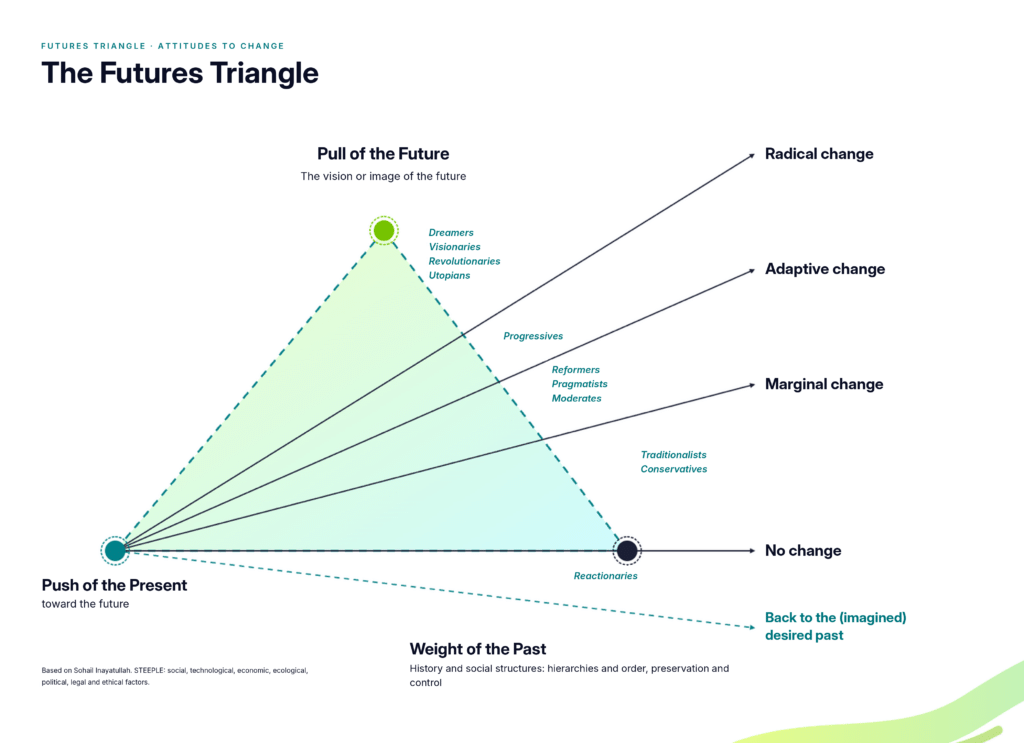
Working with the triangle in a workshop is intuitive: Guided by three questions – What is forcing us to act today? (push), What attracts us? (pull) and What is holding us back? (weight) – participants share stories in rotating World Café rounds and place influencing factors on cards at the corresponding corners of the triangle. This overview of the forces opens up the space to derive plausible futures and develop first strategy drafts later in the process.
For me, the Futures Triangle is a light-footed entry point into strategy processes: it creates a shared language, opens up a view of the bigger picture and connects visionary thinking with pragmatic work on the status quo. Honestly exploring the “weight of the past” in particular is often an eye-opener for teams that regularly struggle to implement their strategies.
The model can also be used fruitfully in organizational development – for example, as a methodological translation of Beckhard’s change formula (). This somewhat unwieldy piece of OD wisdom states that change only succeeds when the interplay of dissatisfaction (Dissatisfaction), vision (Vision) and first concrete steps (First Steps) outweighs the resistance to change (Resistance) (see our Change Essentials cooking show here). The core components dissatisfaction (push), vision (pull) and resistance (weight) map neatly onto the Futures Triangle. The triangle thus becomes a structured framework for dialogue about readiness for change, viable development paths within the field of forces, and sensible first steps on the OD journey. For a deeper dive into the method, see the article The Futures Triangle – Origins and Iterations (Inayatullah 2023).
The Futures Triangle is just one of the tools in the “Six Pillars” futures collection. Perhaps the most profound method in the set is Causal Layered Analysis (CLA), a framework that makes accessible the deep images and metaphors that shape our view of the present and the future, and shows where turning toward something truly new also requires a change in these foundations. Inayatullah explains this U-process of futuring as follows: “To change the future, we must first change the stories we tell ourselves about the present”.
If you are interested in these tools and the critical futures approach, keep your eyes open next year: at the end of April, we are inviting Sohail Inayatullah and his Metafutures partner Ivana Milojević to Berlin for a Futures Thinking masterclass and further events on the theme of imagination.

